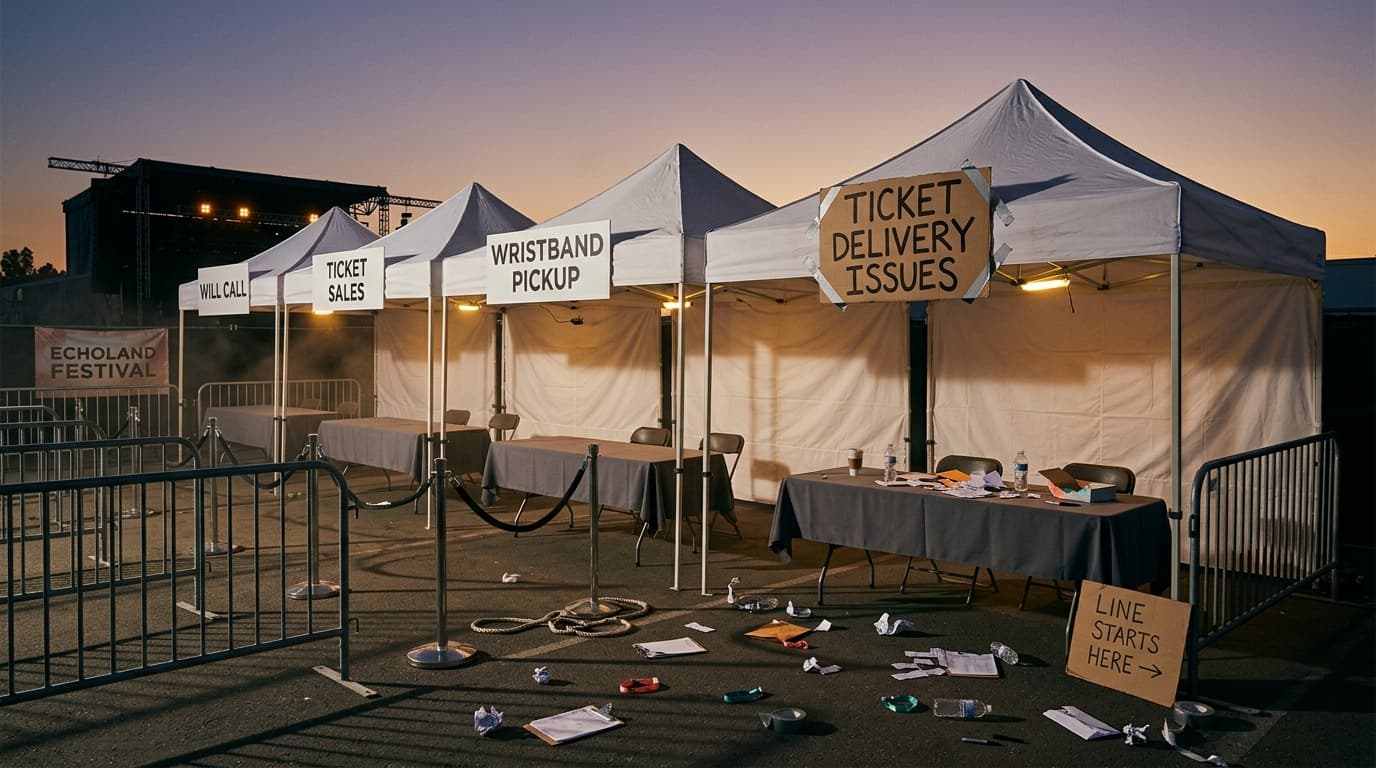
The signal was four days early.
This is the post-event debrief. The deck is up. The refund tally is on slide three. The team has gathered for the same meeting that happens after every event in this industry, the one where we go through what worked, what didn't, and what we'll do differently next time.
Somewhere on the list of what didn't is the wristband fulfillment problem. The one that put more than nine hundred conversations into the inbox in 48 hours, lit up Instagram, and turned the support team's weekend into damage control.
A fix is written down. It will happen at the next event. The deck moves on.
Then somebody says, almost as an aside, that they actually started seeing those questions trending the Tuesday before doors opened.
Tuesday. Four days early.
That's the moment. That's the realization no one quite finishes out loud. We had the signal four days out. We had it again three days out. We had it the morning of doors. And we still didn't have a strategy. The weekend was spent on our heels, answering the same question manually, hundreds of times, while the operations team had no idea what was about to hit them on site.
This is the moment the post-event debrief stops being enough.
Stop running events from the rear-view mirror.
This is the bigger shift, and it's worth saying plainly. We have spent decades in this industry making our biggest learning decisions looking backwards. We notice what broke after the event. We recommit to fixing it next time. We get a little better with every lap.
That model worked because it was the only thing available. Real-time visibility into what was happening across thousands of guest conversations, scoped by specific event, ranked by trend, surfaced as it emerged, was simply not possible. The focus and manpower it would have taken to maintain that view in real time would have been absurd. Nobody was running an event by reading every email as it came in.
That isn't true anymore.
The signals that used to take a week to see are visible the moment they start to form. The patterns that used to wait for a debrief to surface are visible as they rise. The fixes that used to wait for the next event can happen now, while there's still time for them to matter.
The operators who learn to act on what they're seeing in real time will leave the rest behind.
The debrief earned its place.
It's worth being clear about what the post-event debrief is and isn't.
The debrief is not a mistake. It is one of the most important rituals this industry has, and it has produced most of the operational improvements we live by. It's where you learn what your vendors really delivered. It's where the calls made under pressure finally get re-examined with the benefit of hindsight. It's where the GM and the operations director compare notes about how the gate plan held up under stress. It's how event operators actually evolve over years.
In a debrief-only model, every issue that surfaces during the event has to be solved by your team in the moment, on memory, on instinct, on whatever pattern recognition the lead on shift can hold in their head. The data behind those issues, the scale of them, the volume of guests affected, the moment they started to spike, all of that gets surfaced after the event, when the only thing you can do with it is take notes for next time.
There is now a layer that runs underneath the debrief, while the event is happening, while you can still do something. Adding it doesn't replace the post-mortem. It frees the post-mortem to be about something more strategic.
The wristband signal you didn't have to chase.
Let's go back to the example.
Wristband and ticket fulfillment is one of the most common pre-event surge categories in this industry. Packages arrive late (or not at all). Names don't match. The will-call line snakes around the block. Whatever the cause, it doesn't take much to get you a thousand emails inside three days.
In the old model, here's what happens. The first conversations come in. They're answered manually. Two days later, the volume has tripled. The team is now noticeably behind. Three days later, the volume has tripled again. Now you're putting more agents on it. Now somebody on social is complaining publicly. Now the comms team is scrambling for an explanation. Now operations finds out, twelve hours before doors, that there's going to be a will-call problem on site, and they have to invent a plan in real time.
In the real-time model, the moment that question starts trending, you see it. Not at conversation nine hundred. At conversation fifty. The platform tells you what's spiking, how fast, scoped to this specific event, separate from the noise of every other inbox.
That signal alone changes four things at once.
You can re-position your AI. The bot gets a clearer answer, an empathetic acknowledgement, and a routing rule that escalates the right cases instead of guessing.
You get a real read on scale. If fifty guests are asking about it on day one, the AI has the data to project who else is likely to be affected and how that volume curves toward doors. You stop guessing about how big this is.
You get ahead with proactive communication. An email goes out. An SMS goes out. The website FAQ updates. The chatbot greeting changes. Most of those guests don't have to ask anymore.
You get operations involved early. You loop in the on-site team and the vendor, and you build the infrastructure for what's coming. Extra will-call lanes. Better signage. A dedicated escalation queue. The day-of plan looks like a well-organized response instead of a fire drill.
The same nine hundred guests still have a problem. They just experience a calm, prepared organization handling it well, instead of an inbox that drowned and a gate that improvised.
This is what real-time event operations actually surfaces.
The wristband example is one of dozens of patterns that look the same in the data.
A single gate at a venue starts producing escalations at twice the rate of every other gate. A re-entry policy question starts repeating, then accelerating, four hours into doors. A confidence score on the AI's response to a specific lodging question drops, conversation after conversation, because the answer in the knowledge base is from last year's event. Sentiment for guests at one specific check-in starts to crater while the rest of the event holds steady.
In the old model, all of those become bullet points in a post-event report.
In ASQR, those signals are what the Action Center is built to surface. Trending topics, knowledge gaps, sentiment shifts, escalation surges, every one of them tied to a specific event so the noise of one event doesn't mask the urgency of another. The intelligence runs while the event runs.
The principle behind it is simple. Most of the operational disasters in live events are not surprises. They're the visible tip of an underlying pattern that started small, hours or days earlier, and grew because nobody saw the trend. Catch the trend at the start, and most of those disasters never become disasters. They become small, quiet operational adjustments that the guests barely notice.
That is what real-time event operations actually means. Not surveillance. Not dashboards for the sake of dashboards. Just the operational awareness you would already have if you had a team of analysts reading every conversation in real time, scoring it, clustering it, and bringing the patterns to you. You couldn't do it before. You can now.
The debrief stops being damage control.
When real-time is doing its job, the post-event debrief becomes a different conversation.
Tactical fixes don't wait for the meeting. The wristband response was already changed mid-week. The lodging knowledge base was updated as soon as the AI confidence score told you the answer was stale. The gate that was over-escalating got staffed up by Saturday afternoon.
What's left in the debrief is the higher-altitude work. Year-over-year comparisons. Vendor performance across multiple events. Capacity planning for next season. Patterns that only emerge across a portfolio of events, not at any one event in isolation. The strategic shape of the operation, not the firefighting.
That's a better debrief. Not because the meeting got shorter, but because the meeting finally gets to be what it was always supposed to be. A place to think, not a place to clean up.
The operators who level up will leave the rest behind.
The post-event debrief isn't going anywhere, and it shouldn't. It's a foundational practice in this industry, and it has produced most of what we know about how to run live events well.
But the debrief alone is no longer enough. A real-time intelligence layer isn't a luxury or an analytics indulgence. It's the next step. The teams that build it into how they operate will catch the wristband issue at conversation fifty and never have to write that bullet point in the deck. The teams that don't will keep finding out on Tuesday what they could have known last Wednesday.
ASQR is built around that shift. Every conversation across every channel gets analyzed in real time, scoped to the specific event it belongs to, and surfaced through an Action Center that tells you what's spiking and what to do about it. The full picture of why this matters lives in our pillar post, What Is a Guest Intelligence Platform. The AI side of how the system keeps getting better as it sees more conversations is in Closed-Loop Learning.
Stop running events from the rear-view mirror. Explore the platform features or book a 20-minute demo.
Ready to turn guest support into guest intelligence?
See how ASQR helps live events organizations understand their guests better.