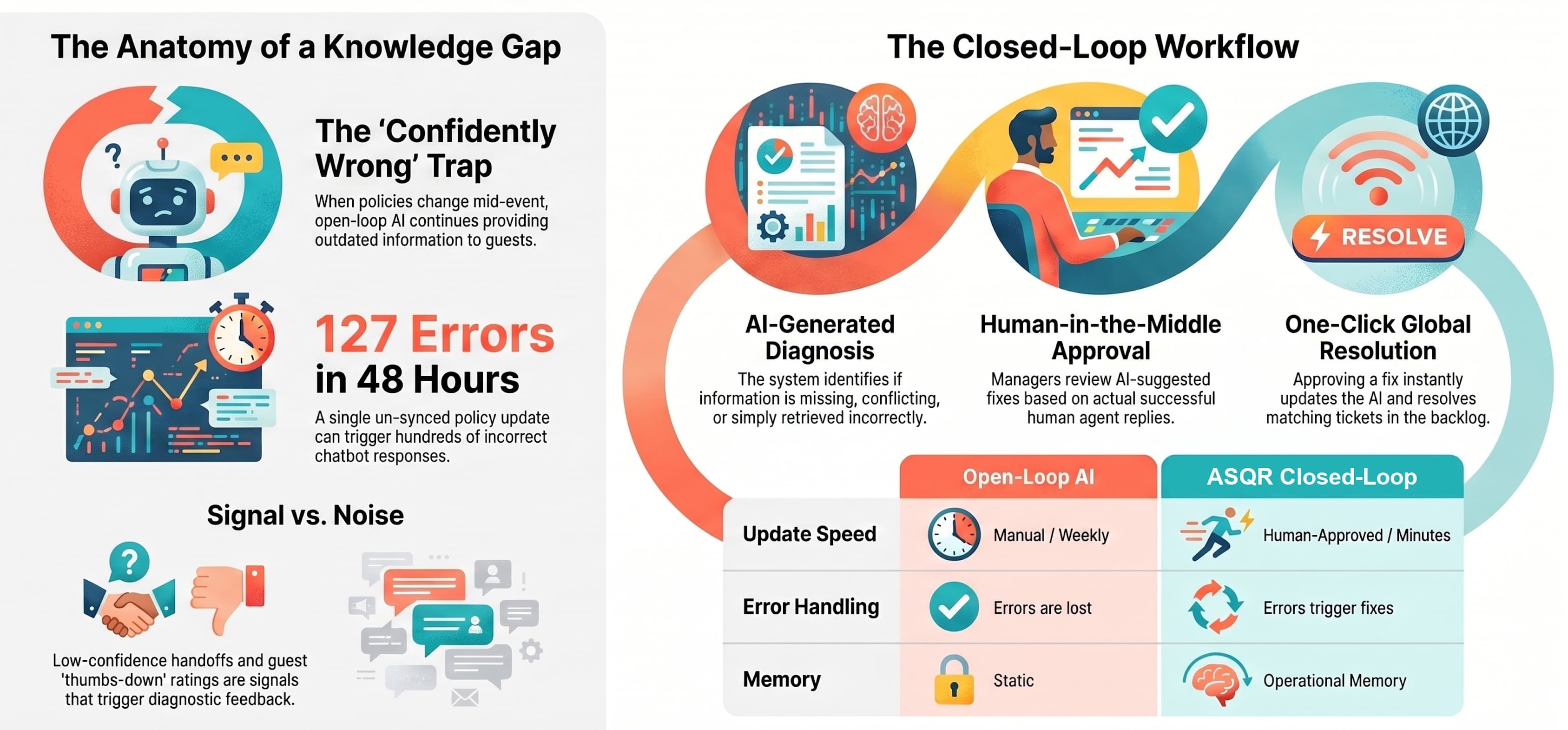
Your venue changed the bag policy on Monday. By Wednesday, your AI has been wrong about it 127 times.
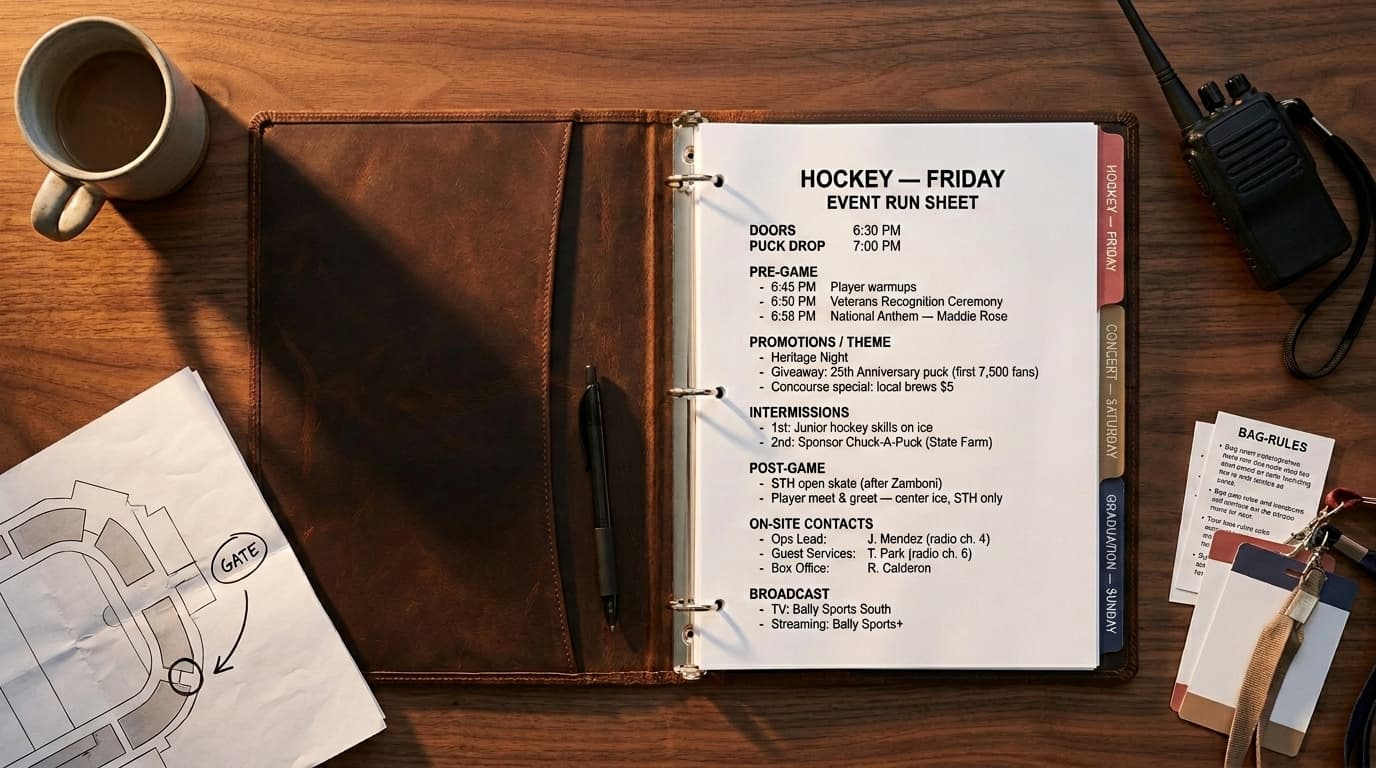
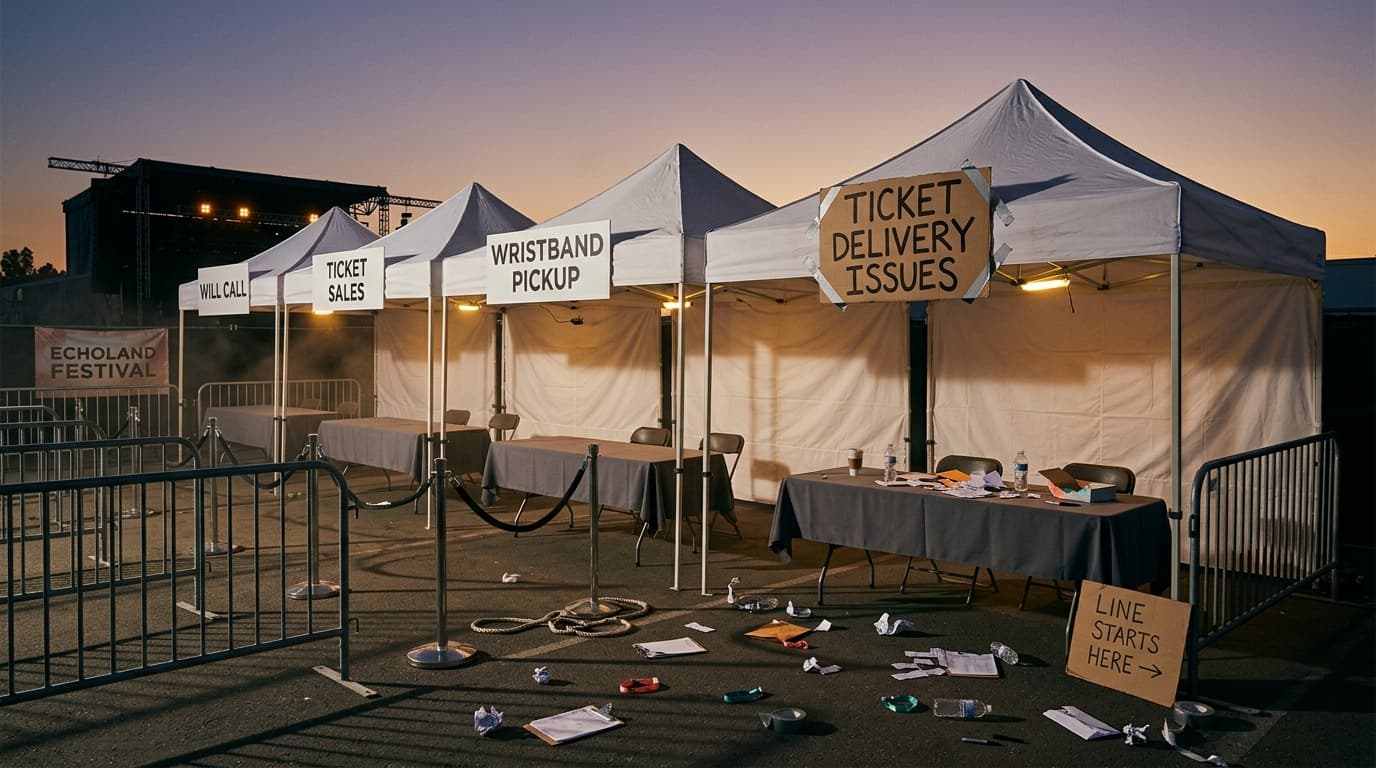
The update went out in an ops email. Your team adjusted signage, briefed the staff, and updated the vendor sheet. Somewhere between that email and the guest-facing knowledge your AI can actually see, the update got lost. By Wednesday afternoon, 127 guests have asked the chatbot about bag size. Some got a confident but outdated answer and walked off with the wrong information. Others didn't buy it. They pushed back, asked again, or opened a ticket. The same question is sitting open in your support queue dozens of times, and your team is working through each one individually, writing the correct answer over and over.
This pattern shows up at every kind of event. A conference changes its wifi password. A festival reroutes arrival traffic. An arena moves VIP entry to a different lobby. A theater reroutes accessible seating around construction. A touring production swaps the merch bundle. A sports venue updates its re-entry policy mid-season. Something shifts between the operations team and the knowledge the AI has access to, and the AI doesn't know yet.
The question isn't whether your AI will be wrong about something you changed yesterday. It will be. Every live event has moving pieces that shift faster than any static knowledge base can track. The real question is how quickly that gap becomes visible, who sees it, and how fast the fix gets in.
Closed-loop learning is how that loop closes. Not by training a smarter AI. By putting a human in the middle of a tight feedback system, so every knowledge gap, every wrong answer, and every missed intent becomes something your team can see, understand, and fix in minutes.
What closed-loop learning actually means
Most AI chatbots are open-loop systems. You train them once. You deploy them. They run. When they get something wrong, the conversation ends and the error vanishes. The next guest asks the same question and gets the same wrong answer. The AI doesn't improve unless someone manually retrains it, which in practice means almost never during the times when it matters most.
Closed-loop learning is the opposite. Real guest conversations feed back into the knowledge base and the classification model. Every wrong answer, every low-confidence handoff, and every thumbs-down becomes a signal that shapes what the AI knows for the next similar question.
One important distinction before we go further. Closed-loop learning, as Asqr implements it, is not autonomous retraining. It's not an AI quietly rewriting the policy it quotes to your guests. Nobody who has run a live event actually wants that. In practice, it's a human-in-the-middle workflow. The AI handles the detection, the diagnosis, and the heavy lifting of suggesting fixes. A person on your team reviews and approves. The system applies the change once a human has said yes.
That distinction is what makes it safe to use inside a live operation. A VP of Operations can trust what the AI is saying to guests because she can see what it knows, how it decided, and what it's about to change before it changes.
The first loop: surfacing knowledge gaps
The most common failure mode isn't a wrong answer. It's the AI not knowing something in the first place. A knowledge gap is when the bot encounters a question where it doesn't have confident information to work from. Sometimes that looks like a wrong answer. More often it looks like the AI correctly handing off to a human because its confidence dropped below the threshold.
Either way, the conversation carries a signal. The value of closed-loop learning starts with how fast your team sees that signal and how much context they have when they do.
Asqr surfaces knowledge gaps scoped to the specific event. You're not looking at a blended dashboard smearing every event your organization runs. You're looking at the gaps inside the conference that's running this week, or the tour date that's tomorrow, or the venue season that just opened. The context matters because the gap matters. "Bag policy" for your arena is not the same question as "bag policy" for your sister venue next door. The scope has to match the operation.
For each gap, you see the signal in one view: the question guests are actually asking; how many have asked it in the last hour, day, or week; the AI's current confidence level; and the topic cluster it belongs to. That alone is more than most helpdesks surface.
The piece that changes the workflow is the context layer. When a gap surfaces, you can see how your agents are already answering that question today. Because the question has been asked 127 times, some of those tickets have already been handled by humans. Your agents wrote the correct answer in their individual replies. The system pulls those replies in as candidate fixes. Your manager doesn't have to draft the knowledge base update from scratch. She reviews what her team has already said, picks the clearest version, edits if needed, and approves.
One click applies the fix. The knowledge base reindexes. The AI starts deflecting the question immediately. And because the same question is sitting open in dozens of tickets, your team can filter by intent and bulk-resolve the backlog with the newly approved answer.
That's closed-loop learning at its most valuable. A gap went from invisible to visible to resolved, with a human in the loop confirming the answer, in the time it takes to review one ticket.
The second loop: when the bot was confidently wrong
The other case looks different. The bag policy update isn't missing from the knowledge base. It's in there. But the old policy is in there too, and the AI confidently returned the outdated version. That's not a knowledge gap. That's a wrong answer.
This is where guest feedback does the detection work. When a guest thumbs-downs a response, the system doesn't just record a rating. It generates a structured Feedback Card.
The card contains the original question, the bot's response, a failure reason, and an AI-generated diagnosis. Was the correct information in the knowledge base but not retrieved? Was it missing entirely? Was the tone off? Was there conflicting content that confused retrieval? The diagnosis narrows what a human reviewer actually has to investigate.
Below that, the card has a ranked list of suggested fixes, an impact estimate, and an effort estimate. Similar failures get deduplicated. "47 guests asked about bag size this month, all got the same wrong answer" shows up as one card, not 47. Fix priority is computed as impact times frequency, divided by effort times risk, so the highest-leverage fixes surface first.
A manager reviews, picks a fix, and approves. One click and the outdated content gets replaced, the knowledge base reindexes, and the bot immediately starts answering correctly.
Same tight loop. Different entry point. Knowledge gaps surface from low-confidence conversations and patterns the AI didn't know how to handle. Feedback Cards surface from guests telling the AI it got something wrong. Both end the same way: a human reviewer, a one-click fix, and an AI that's a little sharper than it was five minutes ago.
Intent classification sharpens quietly in the background
Knowledge gaps and feedback are the loud half of closed-loop learning. The quieter half is intent classification.
Every conversation that comes in gets classified against your taxonomy: Refund Request, Venue Directions, VIP Upgrade, Accessibility, and so on. Clean intent data is what makes analytics meaningful, what routes conversations to the right queue, and what lets a manager filter a backlog of 200 similar tickets and resolve them in bulk.
New intents surface automatically from ticket patterns. When enough conversations cluster around a topic the current taxonomy doesn't cover, the system suggests a new intent. Managers review the suggestion and approve or edit the name. The system then auto-reclassifies historical conversations that match. What was showing up as "Other" becomes a named category that analytics can track and macros can target.
Over one event season, the taxonomy goes from generic to operationally useful. "Parking" becomes "Parking, Lot D shuttle timing." "Seating question" becomes "Accessible seating, rerouted for Section 200 construction." The categories match how your team actually thinks about problems, not how a generic helpdesk thought about problems when it shipped.
One rule matters here. Intent classification is customer-only. Agent-suggested topics get excluded from the counts. This prevents internal tagging from inflating what looks like a guest-driven trend. The taxonomy reflects what guests actually asked about, which is the only signal worth planning around.
Why event AI needs per-event scope
The same closed-loop mechanism inside a generic helpdesk doesn't deliver the same result. The reason is scope.
Every event generates unique knowledge gaps. The bag policy for your arena is not the bag policy for your conference venue. The shuttle route for this year's festival is not the shuttle route for last year's. The rain plan for your outdoor amphitheater doesn't apply to your indoor theater down the street. Without per-event scope, these become noise inside a shared knowledge base that tries to serve everyone at once and ends up confusing everyone.
Per-event AI training is what makes the loop useful. Each event has its own knowledge base, its own intent taxonomy, and its own feedback history. The gap your manager closes at Friday's gate is already deflecting the same question by Saturday morning. The intents that surface mid-weekend are ready for the rest of the run. Improvements compound inside the event, where they pay off most.
Without closed-loop learning, the answers your team wrote in real time die when the event ends. They live in individual agent replies, maybe in a Slack channel nobody reviews after the teardown. With closed-loop learning, they become operational memory. Fewer unknown questions next time. Faster detection when something new emerges.
This is part of why a guest intelligence platform is a different category from a helpdesk with AI bolted on. The category isn't defined by what the AI can answer. It's defined by how the AI gets better, and who gets to decide what "better" means. (More on why generic helpdesks can't deliver this.)
The human in the middle is the point
Fully autonomous AI retraining sounds compelling in a pitch deck. It's uncomfortable in practice. Nobody running a live event actually wants an AI silently rewriting the policy it quotes to guests. The risk of a bad update propagating to thousands of conversations before anyone notices is too high, and the cost of "the AI said the wrong thing and we didn't know" gets paid in refunds, reviews, and reputation. Then it gets paid again in the hours nobody has, pulling threads to figure out what the AI said, when it started saying it, and how to unwind it before more guests see it.
The loop Asqr keeps closed is one where the human stays at the decision point. The AI takes everything that's hard: detecting the pattern, diagnosing why it failed, pulling the relevant context from agent replies, ranking the possible fixes, estimating impact and effort. The manager takes what should be human: reviewing the evidence, choosing the right answer, deciding when to apply it.
What that looks like in practice is a queue that takes ten minutes to review thoroughly on a normal morning, or a two-minute quick scan during an event weekend. Highest-priority Feedback Cards at the top. Knowledge gap alerts next to them. One-click actions for the obvious ones. Snooze or dismiss for anything not worth acting on. The AI is always asking. The human is always answering.
That's closed-loop learning that actually works inside an operation. Not autopilot. Not magic. A tight feedback system that makes the AI a little better every conversation, with someone you trust at the wheel.
The goal was never a perfect AI. Perfect AI doesn't exist. The goal is an AI your team can actually use, that gets measurably better every week, and that never changes what it says to guests without a human saying yes first. AI chatbots for live events that don't have this loop drift by week four, get ignored by guests by week eight, and get distrusted by teams by month three. The ones that do have it stay useful through every event cycle, across every seasonal change, for as long as your team keeps reviewing the queue.
See how closed-loop learning works inside a real guest intelligence platform. Explore the Asqr platform or book a 20-minute demo.