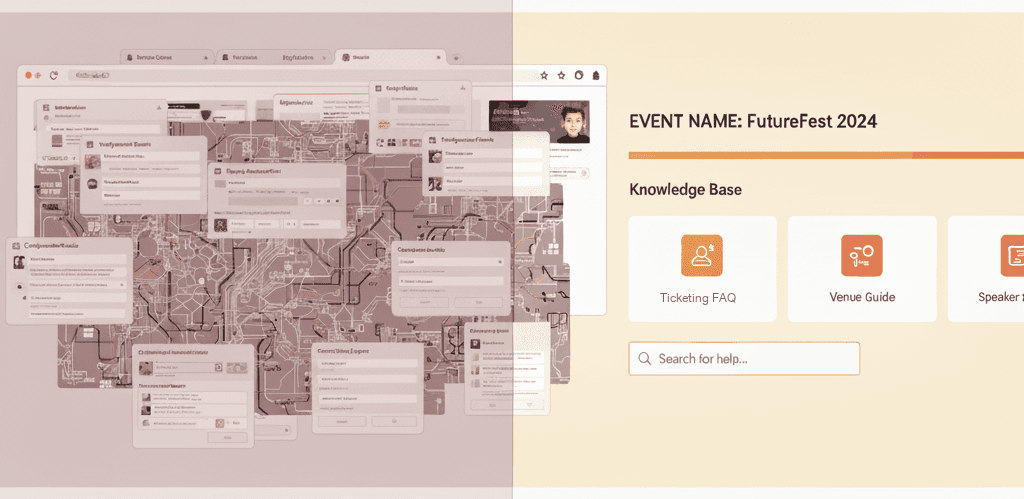
The configuration tax is killing your guest experience
Your team just spent two weeks setting up AI chat for your summer festival season. Tagging hierarchies to separate events. Conditional automations to route questions to the right knowledge base. Separate help centers per brand. Custom fields layered on top of custom fields to scope content so the chatbot doesn't serve arena answers to festival guests.
It works. Mostly. Then someone asks you to add three more events and you realize none of it scales without rebuilding half the configuration from scratch.
This is the reality for event teams using an AI chatbot on platforms that weren't built for live events. The chatbot itself isn't the problem. The problem is what it costs your team, in time, money, and complexity, to make it function for an industry these tools were never designed for. That configuration tax compounds with every event you add, every season you run, and every mid-event change your ops team needs to push live.
Your team didn't sign up to be platform administrators. They signed up to run events.
You shouldn't need a helpdesk architect to run event support
Platforms like Zendesk, Freshdesk, and Intercom offer AI chatbot features that train on your entire help center. Can you make them work for events? Technically, yes. You can build tagging hierarchies, configure conditional automations, set up separate help centers per brand, and layer custom fields to scope content by event.
But the kind of admin who can architect these workarounds is either expensive to hire or expensive to contract. Some organizations outsource the configuration to consultants or agencies. Even if you have the expertise in-house, the time required to build and maintain it pulls your team away from the work that actually matters.
The logic also runs against how event operators naturally think about information. You don't think in tags and database fields. You think in events. This event has this parking map, this entry procedure, this set of vendors. When you're three weeks out from a festival and your ops team needs to update a gate change, the last thing they should be doing is navigating a help center admin panel designed for SaaS knowledge base management.
There are platforms closer to the events space. Satisfi has done solid work organizing event-specific guest communication. But they haven't solved the harder problems: rapidly scaling AI across dozens of events, self-service training that ops teams can manage without vendor support, and feedback loops that make the AI smarter after every interaction. They're also not a helpdesk, so you're still running a separate support platform alongside them. And the pricing and hands-on implementation requirements put them out of reach for many organizations.
The workarounds exist. They're just expensive, fragile, and counterproductive to the speed that live events demand. (For a deeper look at where these platforms break down, see why generic helpdesks fail for events and experiences.)
Why live events break the generic model
The core issue is structural. Live events have three characteristics that generic AI training isn't designed for.
Multiple truths. Your organization runs a music festival in June, a food and wine event in September, and an arena concert series year-round. Each has different parking maps, entry procedures, refund policies, accessibility accommodations, and vendor relationships. A chatbot trained on all of them simultaneously can't reliably distinguish between them.
Temporary truths. Event information changes constantly. A parking lot closes mid-event. A set time shifts by 30 minutes. A gate opens early due to weather. A chatbot trained on static help center documentation can't reflect changes that happen during the event itself.
Surge context. When 500 guests ask about the same entrance gate within two hours, that's not just a support volume problem. That's an operational signal telling you something changed on the ground. A generic chatbot handles each question in isolation. It has no mechanism to recognize the pattern and surface it to your operations team.
These aren't edge cases. They're the defining characteristics of live events support.
Support tools that scale with your events, not tools you scale around
The fix isn't better configuration or more FAQ entries. It's a platform where every event gets its own AI with its own knowledge base, the architecture enforces the separation your team has been building by hand, and the AI lives inside your helpdesk workflow so humans and external collaborators can step in the moment a conversation needs them.
When a guest opens chat for your music festival, the AI draws exclusively from that festival's knowledge. Parking maps, entry procedures, set times, vendor locations. Nothing bleeds in from your other events. Some information, like your organization-wide refund policy or accessibility standards, applies across all events. The system scopes knowledge at three levels: organization-wide, brand-specific, and event-specific. The AI assembles the right combination for each conversation automatically. No tagging hierarchies. No conditional logic. No configuration tax.
When your ops team closes Parking Lot D on Saturday afternoon, the knowledge base reflects that change within minutes. The AI starts routing guests to the right lot before your support team even sees the first message about it.
A guest sends a message: "I bought the VIP upgrade but my ticket still shows GA. Also, what time do doors open?" The AI recognizes two distinct questions. It answers the doors question from the knowledge base and routes the ticket issue to a human agent who has the full conversation context. No repeating the problem. No dead ends.
When the AI encounters something it can't answer reliably, it doesn't guess. ASQR's confidence scoring system evaluates the quality of the knowledge match before responding. If confidence drops below the threshold, the AI acknowledges the gap and connects the guest with a human. If a question needs someone outside your support team, like a venue ops manager or a third-party vendor, ASQR's escalation system brings them into their own portal with the entire conversation history. No forwarded emails. No lost context.
And the system gets smarter over time. If 34 guests ask about "Parking Lot D location" and the AI's confidence averages 23%, that surfaces as a knowledge gap with a recommended fix and an estimated impact: add a Lot D FAQ entry, prevent 34 escalations per week. Guest thumbs-down feedback triggers a review pipeline. Agent responses to escalated questions become knowledge base improvement suggestions. Nightly regression tests catch accuracy drift before it reaches guests. It's a closed loop that compounds across every event you run. That's AI customer support built for live events, not adapted for them after the fact.
This is what it means to move from a chatbot to a guest intelligence platform. Not just answering questions faster, but understanding what your guests are telling you and feeding that intelligence back into your operation.
Join our Founding Partner Program →
See how per-event AI training works for your operation. Explore ASQR's platform features or book a 20-minute demo.
Ready to turn guest support into guest intelligence?
See how ASQR helps live events organizations understand their guests better.